 “A coal miner’s daughter”, is what my Grandma Edna Jagger Muffley called herself. Her father, James Jagger-pictured-(b. 1843, Southowram), indeed worked in the mines in West Yorkshire, and County Durham, in England, and then later in Illinois. Early in life both of his parents died (which found him then in an orphanage), his first wife died in Illinois, and he had a life of hard physical labor. However, his second marriage (to my great-grandmother Frances Weidenhamer) was reportedly happy, and they raised a large fine-looking family of good people. I feel particularly close to this branch of my ancestry, not only because of my early experiences with them, but also due to such a large legacy left to me in photos and history. In addition to this wealth of information, I have visited ancestral locations in West Yorkshire, Illinois, and elsewhere. Hardyman cousins (James Jagger’s mother was Mary Hardyman) have welcomed into their English homes my wife Kathryn and myself. This blog is a summary of highlights of this interesting ancestry.
INTRODUCTION
“A coal miner’s daughter”, is what my Grandma Edna Jagger Muffley called herself. Her father, James Jagger-pictured-(b. 1843, Southowram), indeed worked in the mines in West Yorkshire, and County Durham, in England, and then later in Illinois. Early in life both of his parents died (which found him then in an orphanage), his first wife died in Illinois, and he had a life of hard physical labor. However, his second marriage (to my great-grandmother Frances Weidenhamer) was reportedly happy, and they raised a large fine-looking family of good people. I feel particularly close to this branch of my ancestry, not only because of my early experiences with them, but also due to such a large legacy left to me in photos and history. In addition to this wealth of information, I have visited ancestral locations in West Yorkshire, Illinois, and elsewhere. Hardyman cousins (James Jagger’s mother was Mary Hardyman) have welcomed into their English homes my wife Kathryn and myself. This blog is a summary of highlights of this interesting ancestry.

WALKER-JAGGER OF SOUTHOWRAM & DNA
This Walker family http://kittybrewster.com/
It seems highly likely that William Walker (b. 1749) at http://kittybrewster.com/
William Walker (b. 1749) had a paternal-line great-grandmother Sarah Mortimer (d. 1702) who married William Walker (1665-1714) on 3 May, 1685. At AncestryDNA, I have an 18.2 centiMorgans shared chromosomal segment with the author of this tree:https://www.ancestry.com/
The author of this tree is Randy’s Walker-of-Birstall yDNA match:
https://www.ancestry.com/
My probable 8th great-grandfather Abraham Walker (1629-1695; m. Ann Langley) was a contemporary of Dave’s Robert Walker (1619-1663) & they seem almost certainly to have been yDNA kin to one another. How much further back to the Most Recent Common Ancestor on yDNA? Somewhere around that generational level may have been the MRCA for West Yorkshire versus Walker migrating to America in the 1600s.
At www.gedmatch.com my kits are T203534 & A693287. Dave is T545037, which is not strictly my atDNA match at the default cutoff of 7cM. Nevertheless, we have several potentially interesting In-Common-With persons.
My proposed 8th great-grandfather Abraham Walker (b. 1629) married Ann Langley (b. 1643). At AncestryDNA I have an atDNA match with Phaedra, who has Langley of West Yorkshire ancestry. Thus, my own atDNA has matches to a large number of people with these West Yorkshire ancestries: Walker, Langley, Mortimer, & Haigh. All consistent with the formulation at http://kittybrewster.com/
In the Leeds Intelligencer of 4 January, 1785, Mary Jagger of Southowram was convicted of violation of the Worsted Act. The magistrate was William Walker. This magistrate may have been William Walker JP (1713-1786), grandfather of Mary’s child William Jagger (b. 1781) by his son William Walker (b. 1749). This latter William Walker was a brother of John Walker (b. 1753) father of Ann Walker (b. 1803) who married Anne Lister, who was “Gentleman Jack” of Shibden Hall. The HBO production of “Gentleman Jack” included in its music soundtrack contributions by my known Jagger & atDNA cousin Chris, who would be distant kin to Ann Walker. Ann was likely my 1st cousin 5 times removed.
My 7th great-grandfather William Walker (b. 1665; m. Sarah Mortimer) had a brother Richard Walker (b. 1672). Richard’s daughter Ann married Abraham Sharp. Jack Sharp, my probable distant kinsman & all-around despicable character, appears to have been the inspiration for Heathcliff in Emily Brontë’s “Wuthering Heights”. In 1837, Emily Brontë taught for 6 mos. at Law Hill House boarding school at Southowram. At that time my John & Mary Hardiman Jagger were probable living at Gardeners Square Halifax, where they were found in the 1841 census. Did our John Jagger know that his father William Jagger (b. 1781) was a genetic Walker? And that he was a cousin of Ann Walker of Shibden Hall? Perhaps not. Also in 1837 the Halifax Union Workhouse opened; our James Jagger (b. 1843) landed there when he was age 8, after the deaths of his parents. Later in life, his Smith friends in Batley wrote to him that while his early life was hard, eventually he had a good family & good life in Illinois.
WALKER WAS MYSTERY MAN
The parents of William Jagger (born about 1781, Southowram) were Mary Jagger and a man with Walker yDNA. My cousin Randy Jagger’s yDNA matches several men in Walker Group 20 at the Walker surname yDNA Project at
www.familytreedna.com/public/Walker%20DNA%20Project%20mtDNA%20Results/default.aspx?section=yresults
Currently, Randy’s nearest matches listed at FTDNA are 60 of 67 STR (Short Tandem Repeats) yDNA markers. Randy has a 59 of 67 markers match with Dave Walker (Kit number 352904) whose ancestry was associated with Birstall, West Yorkshire. A bit east of Southowram. Some Walkers of Liversedge, Cleckheaton, & Birstall are likely DNA kin to our Jaggers.
Here is the probable Walker ancestry of Dave: http://wc.rootsweb.ancestry.com/cgi-bin/igm.cgi?op=GET&db=nickmartin&id=I24250
William Jagger and his wife Martha Wilkinson were Most Recent Common Ancestors for Chris West & me, so our “Jagger-Wilkinson” autosomal DNA shared chromosomal segments might also contain a trace from William’s Walker father. Chris & I have some joint atDNA matches whose ancestries remain to be identified. There is hope of further progress via DNA.
By 1545, Walker was reportedly one of the most prolific of West Yorkshire surnames, according to Yorkshire Surnames Series, Part Three: Halifax & District, by George Redmonds. A Walker was a man who operated a manorial fulling-mill. The surname is thought to not have been single-origin. So, only some of the many Walker men of West Yorkshire bear the yDNA signature that we have found in our Jagger line. There are several Walker researchers among the membership of the Calderdale Family History Society. Some Walker families were part of an inter-related group in the weaving industry, which focused particularly upon Birstall and Batley. http://maggieblanck.com/Land/WE.html
A Walker family owned Walterclough Hall in Southowram https://en.wikipedia.org/wiki/Walterclough_Hall at the time that Mary Jagger (b. 1759) of Southowram became pregnant by some Walker man. Some happenings at Walterclough Hall were part of the inspiration for Emily Brontë’s Wuthering Heights. https://en.wikipedia.org/wiki/Wuthering_Heights The Walker family of Walterclough Hall reportedly were religious non-conformists, as were the family of our William & Martha Wilkinson Jagger, whose kids were baptized at the Square Chapel Independent Church in Halifax. There were also Walker people in Elland that were reportedly associated with Square Chapel. Birth, baptism, and burial records for Square Chapel may prove helpful, seeking any Jagger, Walker, & Wilkinson entries.
In the 1841 census of Southowram, our William Jagger, genetic son of Walker, was a wool comber. There are some Walker families in the 1841 census of Southowram. The listing includes Ann Walker (1803-1854), who lived at Shibden Hall in 1841. https://lowercalderlegends.wordpress.com/2010/03/18/the-ghosts-of-shibden-hall/ http://freepages.history.rootsweb.ancestry.com/~calderdalecompanion/qq_170.html This Ann Walker was the heiress to Crow Nest Mansion, Cliffe Hill Mansion in Lightcliffe, & also heiress to Shibden Hall until her death in 1854. The Calderdale Companion tracks Ann Walker’s ancestry back a considerable distance. There is a tie-in to Walker of Walterclough Hall, but any connection to Dave Walker’s ancestry has yet to be detected.
My wife Kathryn & I visited Shibden Hall in 2004, but at that time I was unaware of a Walker connection to Shibden, or that I even had Walker ancestry. Our Shibden Hall guides, & general Calderdale ancestral-tour hosts, were my Hardyman cousin Philip Aaron & his wife Val. My ancestor Mary Hardyman Jagger was a daughter-in-law of William & Martha Wilkinson Jagger. Mary’s sister Betty Hardyman married Benjamin Aaron, whose shoe shop in Halifax has subsequently enjoyed a continuous existence for over 2 centuries. www.baaron-son.co.uk/
Randy’s yDNA indicates Haplogroup I1-M253. Values on key STR markers are consistent with Clan AABA, at www.goggo.com/terry/HaplogroupI1/ This particular clan is notably found in Wales and England. Note at this site that most of the Mesolithic ancestry (I-M253) is said to have arrived from Scandinavia: https://en.wikipedia.org/wiki/Genetic_history_of_the_British_Isles West Yorkshire had a substantial Mesolithic era presence. Future research may shed more light upon our Walker/Jagger deep ancestry.
WILKINSON and ROBERTSHAW ANCESTRY
WILKINSON ANCESTRY
The Wilkinson surname was widespread in West Yorkshire by the 1379 poll tax, & is multi-origin. Our line of interest looks to be solid down from my 5th greats Robert Wilkinson Sr. (m. Mary Lonsdale), & this couple show up on AncestryDNA’s Thru Lines autosomal DNA analyses. Robert Wilkinson Jr. (m. Rose Robertshaw, Nov. 6, 1769, Halifax) were Most Recent Common Ancestors for descendants of our Martha Wilkinson (b. 1784; m. William Jagger) versus descendants of these sibs of Martha: James Wilkinson (m. Hannah Mitchell); & Mally Wilkinson (m. David Brier). Mally’s descendant Blanche Peel (b. 1889) married Reginald Akroyd, & their descendants account for some (or all?) Akroyd autosomal DNA matches with our Wilkinson line. G.A., descendant of my 5th cousin Harry Akroyd, has with me 19 centiMorgans of shared chromosomal segment at AncestryDNA. Unknown person Willie Akroyd (b. 1893, Bradford) has a grand-daughter who has with me a 26 cM shared segment, but conclusions are not yet possible as to common ancestry.
In the 1841 census of Southowram, my 3rd great grandfather William Jagger (b. 1781) was a wool-comber. Other kin in the area were weavers. Some may have been employed by John Wilkinson Hoyle Wheelwright: http://www.calderdalecompanion.co.uk/mmw585.html#1171 This man had Wilkinson ancestry, as did his son-in-law Wilkinson Crossley, who was associated with Broad Carr House & estate. http://www.calderdalecompanion.co.uk/mmc133.html#1049 and
http://www.calderdalecompanion.co.uk/b.html#b1398
John Wilkinson Hoyle Wheelwright’s parents were John Hoyle (Wheelwright) & Sarah Wilkinson, married 28 Aug. 1806, St. John, Halifax.
On 23 February 1746/47, St. John, Halifax this couple were married: Moses Wilkinson & Ruth Hoyle. These are ancestors of Gratia, one of my closest Wilkinson autosomal DNA cousins. GEDmatch Kit # T949417. Gratia has a sizable shared segment with me on Chromosome 16, & this segment triangulates with several other people, indicating a common ancestor for all in this group. Dale (Kit # A162065) is part of the Chromo 16 triangulation with Gratia & others. The Most Recent Common Ancestors for Dale & me: Robert Wilkinson & Rose Robertshaw, parents of my Martha Wilkinson Jagger.
The GEDmatch Multi-Kit analyzer in 2019 has the Chromosome 16 shared segment straddling the centromere (the part holding together 2 parts of the chromosome & the junction of the chromosome’s P Arm versus Q Arm). Currently, the P Arm & Q Arm are treated as 2 segments, but in 2018 the Multi-Kit analyzer showed 1 segment, with P & Q portions. Family Tree DNA still shows the 1-segment solution. My local DNA Working Group’s Ph.D. geneticist favors the 1-segment solution. Cousin T949417 has with me 14.5 cM on the P Arm & 16.6 cM on the Q Arm, for a total of 31.1 cM. This might seem to be the relevant figure for estimation of number of generations back to Most Recent Common Ancestor (MRCA). AncestryDNA calls her my 4th cousin, i.e. MRCA = 3rd greats. That cannot be quite right. Blaine Bettinger’s data finds an average of 36 cM for MRCA = 3rd greats, but with a considerable range of variation. If we could identify the parents of Moses & of our Robert Wilkinson Sr., we might be close to a solution. Possibly Wilkinson kin living in the early 1700s in the immediate Halifax vicinity.
On December 26, 1804, my 3rd great-grandparents Martha Wilkinson & William Jagger (son of William Walker & Mary Jagger), both of Southowram, were married in Halifax. At that time, the Square Chapel Independent (Congregational) church was in existence. Martha & William later christened their kids there. Martha’s older sister Mally Wilkinson had married David Brier in Halifax in 1798. Mally appears in Square Chapel records. Martha’s & Mally’s brother James Wilkinson married Hannah Mitchell, July 28, 1811. James’ & Hannah’s daughter Ruth married John Yates, & this is a line which migrated to Australia. See tree of NelsonD93, my 5th cousin, whose atDNA triangulates on Chromosome 16 with Gratia & several others.
Martha Wilkinson & William Jagger were the Most Recent Common Ancestors for Chris & myself. His very helpful tree: https://www.ancestry.com/family-tree/person/tree/40571300/person/19552560289/facts
ROBERTSHAW ANCESTRY
Rose Robertshaw (m. Robert Wilkinson Jr., 1769, Halifax) was my 4th great-grandmother. Her parents were Jonathan Robertshaw & Mary Pearson, who were married in Bradford Dec. 27, 1739. Fifth greats are as far removed as AncestryDNA’s Thru Lines will venture. The DNA picture for Robertshaw might be simpler than for Wilkinson. My atDNA cousins listing Robertshaw ancestries are a smaller group than are the Wilkinson-ancestry cousins. At AncestryDNA in 2019, there are only a handful, besides known close cousins, of atDNA cousins listing Robertshaw ancestries. Even less at Family Tree DNA.
At AncestryDNA & GEDmatch, I have a sizable Chromosome 2 shared chromosomal segment with Ian (Kit # NT8334534), a reported descendant of Rachel Robertshaw (christened 27 March 1780, Birstall). She married Isaac Ovenden, 1799, Birstall. This Chromosome 2 shared segment is triangulated with several other people, indicating common ancestry for all. GEDmatch kits QL1971207, TG8034224, A258870, & M592465.
At www.GEDmatch.com Kit # T746958 from FTDNA belongs to Gail, a descendant of Elkanah Robertshaw (b. 1712) of Bradford. Her Chromosome 19 shared segment with me is also shared with Cousin Chris. My Most Recent Common Ancestor with Chris was Martha Wilkinson (m. William Jagger), daughter of Rose Robertshaw Wilkinson.
West Yorkshire Robertshaw yDNA falls into 2 main groups (1) Haplogroup I1-P109; & (2) Haplogroup R1b-P312-DF27-ZZ12-Rox 2 STR Cluster-Terminal SNP BY65304 or BY49975. Identification of which yDNA group (if either) corresponds to our autosomal DNA Robertshaw line may be helpful. The geographic distribution of the two types has a large overlap, & ranges from Heptonstall in the west, eastward to Dewsbury.
In the Robertshaw yDNA Project, Kit 376643 in the Haplo R1b Rox2 group reports descent from William Robertshaw, b. 1804 Heptonstall. An online tree https://www.ancestry.com/family-tree/tree/114520269/family/pedigree reports that the father & grandfather of this William lived in Birstall. This Grandpa William Robertshaw Sr. (b. 1745) reportedly died in 1812 in Birstall. At the moment it seems possible that my Robertshaw atDNA might correspond to the yDNA Haplogroup R1b Rox2 & a Birstall connection. Birstall lies southeast of Bradford, scene of the 1739 wedding of Jonathan Robertshaw & Mary Pearson, my 5th greats.
At this URL https://www.ytree.net/DisplayTree.php?blockID=29 Terminal SNP = BY65304 is currently focal to the same Robertshaw R1b-P312-DF27-ZZ12-Rox2Cluster-BY49975-BY65304 group appearing in the Robertshaw yDNA Project. At https://sites.google.com/site/rox2cluster/ find the sentence “…old West Riding of Yorkshire families….” & “Big Tree leads this branch with BY49857 and seven equivalents. See the FTDNA Robertshaw DNA Project.” And “The Rox2 common ancestor lived only 1000-1500 years ago and that means that the STR haplotypes of his descendants remain similar enough to be clearly identified today. Identification is made using the key STR markers of the Rox2 signature pattern.” I have corresponded with Ollie, whose yDNA falls into this group.
The Wilkinson surname was widespread in West Yorkshire by the 1379 poll tax, & is multi-origin. Our line of interest looks to be solid down from my 5th greats Robert Wilkinson Sr. (m. Mary Lonsdale), & this couple show up on AncestryDNA’s Thru Lines autosomal DNA analyses. Robert Wilkinson Jr. (m. Rose Robertshaw, Nov. 6, 1769, Halifax) were Most Recent Common Ancestors for descendants of our Martha Wilkinson (b. 1784; m. William Jagger) versus descendants of these sibs of Martha: James Wilkinson (m. Hannah Mitchell); & Mally Wilkinson (m. David Brier). Mally’s descendant Blanche Peel (b. 1889) married Reginald Akroyd, & their descendants account for some (or all?) Akroyd autosomal DNA matches with our Wilkinson line. G.A., descendant of my 5th cousin Harry Akroyd, has with me 19 centiMorgans of shared chromosomal segment at AncestryDNA. Unknown person Willie Akroyd (b. 1893, Bradford) has a grand-daughter who has with me a 26 cM shared segment, but conclusions are not yet possible as to common ancestry.
In the 1841 census of Southowram, my 3rd great grandfather William Jagger (b. 1781) was a wool-comber. Other kin in the area were weavers. Some may have been employed by John Wilkinson Hoyle Wheelwright: http://www.calderdalecompanion.co.uk/mmw585.html#1171 This man had Wilkinson ancestry, as did his son-in-law Wilkinson Crossley, who was associated with Broad Carr House & estate. http://www.calderdalecompanion.co.uk/mmc133.html#1049 and
http://www.calderdalecompanion.co.uk/b.html#b1398
John Wilkinson Hoyle Wheelwright’s parents were John Hoyle (Wheelwright) & Sarah Wilkinson, married 28 Aug. 1806, St. John, Halifax.
On 23 February 1746/47, St. John, Halifax this couple were married: Moses Wilkinson & Ruth Hoyle. These are ancestors of Gratia, one of my closest Wilkinson autosomal DNA cousins. GEDmatch Kit # T949417. Gratia has a sizable shared segment with me on Chromosome 16, & this segment triangulates with several other people, indicating a common ancestor for all in this group. Dale (Kit # A162065) is part of the Chromo 16 triangulation with Gratia & others. The Most Recent Common Ancestors for Dale & me: Robert Wilkinson & Rose Robertshaw, parents of my Martha Wilkinson Jagger.
The GEDmatch Multi-Kit analyzer in 2019 has the Chromosome 16 shared segment straddling the centromere (the part holding together 2 parts of the chromosome & the junction of the chromosome’s P Arm versus Q Arm). Currently, the P Arm & Q Arm are treated as 2 segments, but in 2018 the Multi-Kit analyzer showed 1 segment, with P & Q portions. Family Tree DNA still shows the 1-segment solution. My local DNA Working Group’s Ph.D. geneticist favors the 1-segment solution. Cousin T949417 has with me 14.5 cM on the P Arm & 16.6 cM on the Q Arm, for a total of 31.1 cM. This might seem to be the relevant figure for estimation of number of generations back to Most Recent Common Ancestor (MRCA). AncestryDNA calls her my 4th cousin, i.e. MRCA = 3rd greats. That cannot be quite right. Blaine Bettinger’s data finds an average of 36 cM for MRCA = 3rd greats, but with a considerable range of variation. If we could identify the parents of Moses & of our Robert Wilkinson Sr., we might be close to a solution. Possibly Wilkinson kin living in the early 1700s in the immediate Halifax vicinity.
On December 26, 1804, my 3rd great-grandparents Martha Wilkinson & William Jagger (son of William Walker & Mary Jagger), both of Southowram, were married in Halifax. At that time, the Square Chapel Independent (Congregational) church was in existence. Martha & William later christened their kids there. Martha’s older sister Mally Wilkinson had married David Brier in Halifax in 1798. Mally appears in Square Chapel records. Martha’s & Mally’s brother James Wilkinson married Hannah Mitchell, July 28, 1811. James’ & Hannah’s daughter Ruth married John Yates, & this is a line which migrated to Australia. See tree of NelsonD93, my 5th cousin, whose atDNA triangulates on Chromosome 16 with Gratia & several others.
Martha Wilkinson & William Jagger were the Most Recent Common Ancestors for Chris & myself. His very helpful tree: https://www.ancestry.com/family-tree/person/tree/40571300/person/19552560289/facts
ROBERTSHAW ANCESTRY
Rose Robertshaw (m. Robert Wilkinson Jr., 1769, Halifax) was my 4th great-grandmother. Her parents were Jonathan Robertshaw & Mary Pearson, who were married in Bradford Dec. 27, 1739. Fifth greats are as far removed as AncestryDNA’s Thru Lines will venture. The DNA picture for Robertshaw might be simpler than for Wilkinson. My atDNA cousins listing Robertshaw ancestries are a smaller group than are the Wilkinson-ancestry cousins. At AncestryDNA in 2019, there are only a handful, besides known close cousins, of atDNA cousins listing Robertshaw ancestries. Even less at Family Tree DNA.
At AncestryDNA & GEDmatch, I have a sizable Chromosome 2 shared chromosomal segment with Ian (Kit # NT8334534), a reported descendant of Rachel Robertshaw (christened 27 March 1780, Birstall). She married Isaac Ovenden, 1799, Birstall. This Chromosome 2 shared segment is triangulated with several other people, indicating common ancestry for all. GEDmatch kits QL1971207, TG8034224, A258870, & M592465.
At www.GEDmatch.com Kit # T746958 from FTDNA belongs to Gail, a descendant of Elkanah Robertshaw (b. 1712) of Bradford. Her Chromosome 19 shared segment with me is also shared with Cousin Chris. My Most Recent Common Ancestor with Chris was Martha Wilkinson (m. William Jagger), daughter of Rose Robertshaw Wilkinson.
West Yorkshire Robertshaw yDNA falls into 2 main groups (1) Haplogroup I1-P109; & (2) Haplogroup R1b-P312-DF27-ZZ12-Rox 2 STR Cluster-Terminal SNP BY65304 or BY49975. Identification of which yDNA group (if either) corresponds to our autosomal DNA Robertshaw line may be helpful. The geographic distribution of the two types has a large overlap, & ranges from Heptonstall in the west, eastward to Dewsbury.
In the Robertshaw yDNA Project, Kit 376643 in the Haplo R1b Rox2 group reports descent from William Robertshaw, b. 1804 Heptonstall. An online tree https://www.ancestry.com/family-tree/tree/114520269/family/pedigree reports that the father & grandfather of this William lived in Birstall. This Grandpa William Robertshaw Sr. (b. 1745) reportedly died in 1812 in Birstall. At the moment it seems possible that my Robertshaw atDNA might correspond to the yDNA Haplogroup R1b Rox2 & a Birstall connection. Birstall lies southeast of Bradford, scene of the 1739 wedding of Jonathan Robertshaw & Mary Pearson, my 5th greats.
At this URL https://www.ytree.net/DisplayTree.php?blockID=29 Terminal SNP = BY65304 is currently focal to the same Robertshaw R1b-P312-DF27-ZZ12-Rox2Cluster-BY49975-BY65304 group appearing in the Robertshaw yDNA Project. At https://sites.google.com/site/rox2cluster/ find the sentence “…old West Riding of Yorkshire families….” & “Big Tree leads this branch with BY49857 and seven equivalents. See the FTDNA Robertshaw DNA Project.” And “The Rox2 common ancestor lived only 1000-1500 years ago and that means that the STR haplotypes of his descendants remain similar enough to be clearly identified today. Identification is made using the key STR markers of the Rox2 signature pattern.” I have corresponded with Ollie, whose yDNA falls into this group.
JAGGER UPDATE
New Jagger cousin Chris saw this blog and contacted Gary. Chris’s tree at Ancestry.com
has this new information on the family of John and Mary Hardyman Jagger: Identity of spouses of James Jagger’s (b. 1843) sisters Susanna and Martha; and identity of the kids’ step-mother.
Susanna Jagger (1829-1858) married David Brier Aaron in 1848, shortly after the re-marriage of Susanna’s widowed father John Jagger to Elizabeth Marvell. Jagger family history which was passed to Gary did not mention the sister Susanna at all, nor identify the step-mother. Both Susanna and Martha died in their late 20s.
James’ sister Martha (1839-1866) would have been the sister said to have gone to the orphanage with James. She may have only been there briefly. In the 1851 census, we find James, age 8, alone in the Halifax Union Workhouse. His brother Will and sister Martha were then living with the widowed step-mother Elizabeth “Betty” Marvell Jagger in the home of Betty’s father Thomas Marvell at Bank Bottom, Southowram. Susanna was married by then. John Jr. “Jack” Jagger in 1851 was in the home of the widow Crabtree, at 16 Gardeners Square.
Now here is a shocker. The relevant Gardeners Square is in Halifax, not the Gardeners Square in Hipperholme. Forget all of what I’ve said about Hipperholme. The Halifax Gardeners Square does not appear on current maps, but was reportedly located between Well Lane and King Street, just northwest of the St. John The Baptist parish church. So, this location was quite near several kin, and sites of relevance to the Jagger and Hardyman families: The Aaron shoe shop; the Piece Hall; the Square Chapel independent church; and Southowram. And a long walk down Gibbet Street from the Halifax Union Workhouse.
Between the 1851 and 1861 censuses, several things happened regarding James and his siblings. Will went to America (married in Delaware in 1855). Susannah Jagger Aaron died (1858). James moved in with the family of Uncle Joseph Jagger. Martha may have worked as a servant in the home of Elizabeth Batty. Where was Jack? Had he already gone off to Blackpool? He reportedly ran a hotel in Blackpool, but nothing has been found regarding this.
Martha Jagger (1839-1866) married Joseph Henry Bolton in 1863. Their daughter Annie Bolton (b. 1866) was mentioned in the Jagger history written material which Gary inherited. Annie was probably visited in 1891-1892 by her first cousin Mattie Jagger, daughter of James. And probably by James himself when he went back to England during World War I.
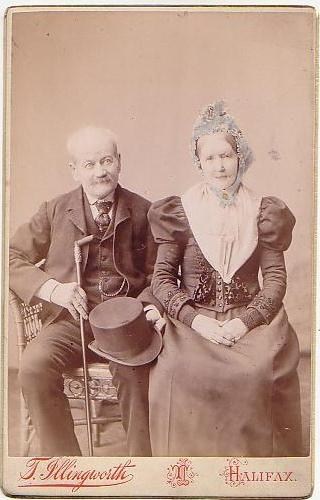 |
Ancestors of Jagger-cousin Chris West:
Samuel Dean (1816-1900) and Elizabeth Jagger (1819-1905).
Elizabeth was an aunt of our James Jagger (b. 1843).
|
WEST YORKSHIRE
James Jagger’s ancestry includes the surnames Hardyman, Wade, Kenion, Rhodes, and Wilkinson. His maternal great-grandfather John Hardyman was a soldier at the time of his March 15, 1769, marriage to Betty Kenion (b. 1753; Betty was the daughter of Thomas and Martha Rhodes Kenion). This marriage was only a few years following the world conflict called the Seven Years War (termed French and Indian War in America). Much later, Arthur Wellesley (the future Duke of Wellington) was associated with West Yorkshire troops. There is a Wellington Chapel with a fine rood screen inside St. John’s Parish Church in Halifax. Several persons of my ancestry were associated with this Church of England parish church, and also with the nearby Square Independent Chapel (visited by John Wesley at a time when my Wilkinson ancestors were members).
John and Betty Kenion Hardyman had a son, William Hardyman Sr. (b. Sept. 15, 1773, Halifax). William was a cloth dresser. He married Susannah Wade (m. June 30, 1794), and later they lived at Gardeners Square in Hipperholme (just northeast of Halifax). Gardeners Square was a place of particular importance to my family, as we shall shortly see. I wrote an article, “Hipperholme Sweet Home” for The Scrivener, a publication of the Calderdale Family History Society.
William and Susannah Wade Hardyman had three children: (1) Elizabeth “Betty” Hardyman; (2) Mary Hardyman; & (3) William Hardyman Jr. Elizabeth (b. July 21, 1799) married Benjamin Aaron, who inherited his father’s shoe shop. The Aaron shoe shop has been in operated by that family continuously since 1810. Philip and Val Aaron escorted Kathryn and me around the Halifax area, fed and entertained us. Their home has many interesting prints of old Halifax. Another Aaron-Hardyman cousin, Elizabeth Paczek, has also received us warmly into her home. I have photos of Benjamin and Elizabeth Hardyman Aaron, which are particularly valued because I have no other photos of kin of that generation.
William Hardyman Jr. (b. Nov. 3, 1805) married Anne Rowbottom. William was a cooper. They had several children, including Hannah Hardyman (b. Sept. 1847). Hannah, a lifelong residence of Halifax, corresponded with her cousin James Jagger in Illinois. I have some of that correspondence, her will, census data, and have seen one of her Halifax residences.
On December 25, 1827, Mary Hardyman (b. April 3, 1803) married John Jagger (b. 1807-1808), and these were the parents of our James Jagger.
John and Betty Kenion Hardyman had a son, William Hardyman Sr. (b. Sept. 15, 1773, Halifax). William was a cloth dresser. He married Susannah Wade (m. June 30, 1794), and later they lived at Gardeners Square in Hipperholme (just northeast of Halifax). Gardeners Square was a place of particular importance to my family, as we shall shortly see. I wrote an article, “Hipperholme Sweet Home” for The Scrivener, a publication of the Calderdale Family History Society.
William and Susannah Wade Hardyman had three children: (1) Elizabeth “Betty” Hardyman; (2) Mary Hardyman; & (3) William Hardyman Jr. Elizabeth (b. July 21, 1799) married Benjamin Aaron, who inherited his father’s shoe shop. The Aaron shoe shop has been in operated by that family continuously since 1810. Philip and Val Aaron escorted Kathryn and me around the Halifax area, fed and entertained us. Their home has many interesting prints of old Halifax. Another Aaron-Hardyman cousin, Elizabeth Paczek, has also received us warmly into her home. I have photos of Benjamin and Elizabeth Hardyman Aaron, which are particularly valued because I have no other photos of kin of that generation.
William Hardyman Jr. (b. Nov. 3, 1805) married Anne Rowbottom. William was a cooper. They had several children, including Hannah Hardyman (b. Sept. 1847). Hannah, a lifelong residence of Halifax, corresponded with her cousin James Jagger in Illinois. I have some of that correspondence, her will, census data, and have seen one of her Halifax residences.
On December 25, 1827, Mary Hardyman (b. April 3, 1803) married John Jagger (b. 1807-1808), and these were the parents of our James Jagger.
JAGGER HISTORY
There is a 1306 Derbyshire record of some Thomas le Jager, but generally the surname is associated with West Yorkshire. A “jag” is a pack, in West Yorkshire dialect, and a jagger was a peddler. It has been said that English Jaggers descend from families in Stainland, West Yorkshire. A Yorkshire poll tax of 1379 reportedly showed only a single Jagger family, located in Stainland (west of Jagger Green). Over time descendants spread, particularly to the east. In West Yorkshire there are: Jagger Green, Jagger Green Hall, Jagger Bridge, Jagger Dam, and Jagger Park Wood.
About 1420, Shibden Hall (a Jagger later married into a family associated with Shibden) was built to the east of Halifax. Philip and Van Aaron kindly gave us a tour of Shibden Hall, which many of my kinfolk must have seen. The present Halifax Parish Church, associated with my ancestry, was begun in 1438, on the site of a Norman church.
About 1758-1759, Mary Jagger (great-grandmother of our James Jagger) was born; her parents are not known. An e-mail cousin has reported that Mary Jagger was not married at the time of birth of her son William Jagger (b. 1781-1782, Southowram). William was baptized at St. John the Baptist, parish church of the Church of England, on February 3, 1782. He was a laborer. William Jagger married Martha Wilkinson on December 26, 1804. Martha had been baptized on November 24, 1874, at the Square Independent Chapel. Their children were baptized at Square Chapel, so do not appear in Church of England records. One of those kids was our John Jagger (b. 1807-1808), who was christened on June 12, 1808, at Square Chapel; the parents were recorded as William and Martha Jagger of Southowram. John’s brother Joseph was to become a significant figure in the life of our James Jagger.
John Jagger was a weaver of Southowram at the time of his December 25, 1827, marriage to Mary Hardyman. He was also listed as a weaver of Southowram at the time of births of their kids Susannah (christened Jan. 25, 1829), William (chr. May 1, 1831), and John Jr. (chr. Nov. 6, 1836). Their daughter Martha Ann was christened on Oct. 30, 1839. As a weaver, John Jagger surely would have frequented the Piece Hall (opened in 1779) in Halifax. Small makers of cloth sold their products to wholesalers at Piece Hall.
About 1420, Shibden Hall (a Jagger later married into a family associated with Shibden) was built to the east of Halifax. Philip and Van Aaron kindly gave us a tour of Shibden Hall, which many of my kinfolk must have seen. The present Halifax Parish Church, associated with my ancestry, was begun in 1438, on the site of a Norman church.
About 1758-1759, Mary Jagger (great-grandmother of our James Jagger) was born; her parents are not known. An e-mail cousin has reported that Mary Jagger was not married at the time of birth of her son William Jagger (b. 1781-1782, Southowram). William was baptized at St. John the Baptist, parish church of the Church of England, on February 3, 1782. He was a laborer. William Jagger married Martha Wilkinson on December 26, 1804. Martha had been baptized on November 24, 1874, at the Square Independent Chapel. Their children were baptized at Square Chapel, so do not appear in Church of England records. One of those kids was our John Jagger (b. 1807-1808), who was christened on June 12, 1808, at Square Chapel; the parents were recorded as William and Martha Jagger of Southowram. John’s brother Joseph was to become a significant figure in the life of our James Jagger.
John Jagger was a weaver of Southowram at the time of his December 25, 1827, marriage to Mary Hardyman. He was also listed as a weaver of Southowram at the time of births of their kids Susannah (christened Jan. 25, 1829), William (chr. May 1, 1831), and John Jr. (chr. Nov. 6, 1836). Their daughter Martha Ann was christened on Oct. 30, 1839. As a weaver, John Jagger surely would have frequented the Piece Hall (opened in 1779) in Halifax. Small makers of cloth sold their products to wholesalers at Piece Hall.
JAGGER HISTORY 1841-1867
The 1841 census finds this John and Mary Jagger family in Gardeners Square, Hipperholme, neighbors of some Moses and Hannah Aaron. John Jagger was then a carter. The children then were Susannah, William, John Jr., and Martha Ann. Not yet born were my ancestor James Jagger (b. 1843, Southowram), nor a brother Thomas. Thomas has not been positively identified in records, but was reported in family history as a brother “lost at sea”. There may also have been a brother Joseph, who died young. The Hare and Hounds Pub is just across the street from Gardeners Square. Go to www.old-maps.co.uk and search for “Hipperholme”. This pub can be seen on an 1854 map; Gardeners Square is just to the left. Go to www.multimap.com and search for “Hipperholme”. Zoom in, and go a bit north up the A644. Center on Gardeners Square, and click “Aerial”. The aerial photograph shows the pub. Some of my kin who lived across the road surely utilized that pub.
There are unsolved mysteries about what eventually became of the siblings of our James Jagger. Apparently Susannah died fairly young, John Jr. was said to have managed a hotel in Blackpool, and Martha Ann reportedly married. James’ brother Will Jagger became a mechanic, and moved to Delaware and Pennsylvania; some is known about his life and descendants.
Also in the 1841 census, we see that John Jagger’s brother Joseph was living in Southowram with their parents William and Martha Wilkinson Jagger. William and Joseph were both wool combers. Nearby lived William’s and Martha’s son Robert and his wife Sarah Robertshaw Jagger. Joseph must have married Mary shortly after 1841.
Some time after the 1841 census, our John and Mary Jagger family may have moved from Gardeners Square to Southowram; his parents may have died about then. Emily Brontë had taught briefly in Southowram in 1837, and later incorporated feuds she had observed into her novel “Wuthering Heights”. Our James Jagger was born at Southowram on April 9, 1843. Also born that year in Southowram was James’ cousin Amelia Jagger, daughter of Joseph Jagger. This cousin Amelia Jagger Hallas years later turned up in Galesburg, Illinois, home then of our James Jagger.
According to family history, some time after James’ 1843 birth his mother died. His father remarried, but then died. The step-mother re-married, and sent the Jagger kids away. James and Martha Ann reportedly went to an orphanage. I haven’t been able to find specifics about the deaths and remarriages in records. It is unknown if the deaths relate at all to a typhus epidemic in 1843-1844 in parts of West Yorkshire.
In the 1851 census, we find our James Jagger, age 8, in the Halifax Union Workhouse. His brother Will, mechanic, appears to be living with some people, possibly with 2 Jagger aunts, at Bank Bottom, near the railway station. James’ brother John Jr. appears to be living at 16 Gardeners Square; he was age 14, and a collier. Cousin Hannah Hardyman was with her parents at 1 Gardeners Square. The whereabouts then of other Jagger sibs is unclear.
James Jagger was 10 in 1853, so old enough for the coal mines legally, which fits with family history. That year the Crimean War began. James’ brother Will may have migrated to Delaware about this time, and in 1855 Will married Elizabeth (Hurst?) in Wilmington, New Castle County, Delaware. One of Will’s sons was named Squire Jagger; it is interesting that Will’s Aunt Hannah Jagger married John Squires.
By the 1861 census, our James Jagger was living at 11 Whitelea Road in Batley (a location of significance for the Jaggers for decades to come) with his Uncle Joseph and Aunt Mary Jagger. Coal mining was the employment of James, Uncle Joseph, and Cousin George. Cousins Amelia (later the wife of Jessie Hallas) and Ann worked in a factory. Other kin are to be found in that census, but James’ sibs remain elusive, except for brother Will, who had been in America for some time; the U.S. Civil War started in 1861.
Some time after 1861, James Jagger moved north to County Durham and began coal mine work there. Perhaps his brother John moved to Blackpool about then, as that city was developing as a holiday destination. No record has been found to back up the family story of John working there as a hotel manager, but Hannah Hardyman made reference in a 1920 letter to some people (known to Hannah & James) in Blackpool. By the way, Sir Mick Jagger, of West Yorkshire ancestry, reportedly had a grandfather David Jagger who died in the Blackpool area.
On October 9, 1867, James Jagger, resident at Sunnybrow coal village, married Jane Emmerson Liddell in Auckland, County Durham. James migrated to Adams County, Illinois, in 1869 (according to a later census), ahead of his wife (according to family history). He may have been associated with a coalmining Ellis family who had migrated from England to Illinois.
There are unsolved mysteries about what eventually became of the siblings of our James Jagger. Apparently Susannah died fairly young, John Jr. was said to have managed a hotel in Blackpool, and Martha Ann reportedly married. James’ brother Will Jagger became a mechanic, and moved to Delaware and Pennsylvania; some is known about his life and descendants.
Also in the 1841 census, we see that John Jagger’s brother Joseph was living in Southowram with their parents William and Martha Wilkinson Jagger. William and Joseph were both wool combers. Nearby lived William’s and Martha’s son Robert and his wife Sarah Robertshaw Jagger. Joseph must have married Mary shortly after 1841.
Some time after the 1841 census, our John and Mary Jagger family may have moved from Gardeners Square to Southowram; his parents may have died about then. Emily Brontë had taught briefly in Southowram in 1837, and later incorporated feuds she had observed into her novel “Wuthering Heights”. Our James Jagger was born at Southowram on April 9, 1843. Also born that year in Southowram was James’ cousin Amelia Jagger, daughter of Joseph Jagger. This cousin Amelia Jagger Hallas years later turned up in Galesburg, Illinois, home then of our James Jagger.
According to family history, some time after James’ 1843 birth his mother died. His father remarried, but then died. The step-mother re-married, and sent the Jagger kids away. James and Martha Ann reportedly went to an orphanage. I haven’t been able to find specifics about the deaths and remarriages in records. It is unknown if the deaths relate at all to a typhus epidemic in 1843-1844 in parts of West Yorkshire.
In the 1851 census, we find our James Jagger, age 8, in the Halifax Union Workhouse. His brother Will, mechanic, appears to be living with some people, possibly with 2 Jagger aunts, at Bank Bottom, near the railway station. James’ brother John Jr. appears to be living at 16 Gardeners Square; he was age 14, and a collier. Cousin Hannah Hardyman was with her parents at 1 Gardeners Square. The whereabouts then of other Jagger sibs is unclear.
James Jagger was 10 in 1853, so old enough for the coal mines legally, which fits with family history. That year the Crimean War began. James’ brother Will may have migrated to Delaware about this time, and in 1855 Will married Elizabeth (Hurst?) in Wilmington, New Castle County, Delaware. One of Will’s sons was named Squire Jagger; it is interesting that Will’s Aunt Hannah Jagger married John Squires.
By the 1861 census, our James Jagger was living at 11 Whitelea Road in Batley (a location of significance for the Jaggers for decades to come) with his Uncle Joseph and Aunt Mary Jagger. Coal mining was the employment of James, Uncle Joseph, and Cousin George. Cousins Amelia (later the wife of Jessie Hallas) and Ann worked in a factory. Other kin are to be found in that census, but James’ sibs remain elusive, except for brother Will, who had been in America for some time; the U.S. Civil War started in 1861.
Some time after 1861, James Jagger moved north to County Durham and began coal mine work there. Perhaps his brother John moved to Blackpool about then, as that city was developing as a holiday destination. No record has been found to back up the family story of John working there as a hotel manager, but Hannah Hardyman made reference in a 1920 letter to some people (known to Hannah & James) in Blackpool. By the way, Sir Mick Jagger, of West Yorkshire ancestry, reportedly had a grandfather David Jagger who died in the Blackpool area.
On October 9, 1867, James Jagger, resident at Sunnybrow coal village, married Jane Emmerson Liddell in Auckland, County Durham. James migrated to Adams County, Illinois, in 1869 (according to a later census), ahead of his wife (according to family history). He may have been associated with a coalmining Ellis family who had migrated from England to Illinois.
ADAMS COUNTY, ILLINOIS
 James Jagger (pictured here with his family from left rear: Edna, Lily, Will, Jess, Ruth, Rose, May, Mattie, front row - Lee, Bessie, James, Frances, Harry, Allie.) settled in the north of Adams County, near the coal mine of John Jacob Weidenhamer III. Soon afterwards, his wife Jane migrated from England to join him. Jane died in childbirth (d. Oct. 28, 1870), and the baby girl died shortly afterwards. They were buried at the Mt. Horeb Cemetery, 5 miles east of the town of Golden. James Jagger roomed with coal mine owner (and farmer and businessman) John Jacob Weidenhamer III (of Baden, Germany ancestry) and his wife Elizabeth Glenn Weidenhamer (her ancestry includes Glenn of Northern Ireland, Tucker of early Jamestown, Cherokee, and Choctaw). On December 25, 1870, our James Jagger married their daughter Frances Fredericka Weidenhamer. The first of their 13 kids was born in 1871, and 12 survived to adulthood (pictured above). Soon after the marriage, James and Frances were baptized into the United Brethren Church. They lived, while in Adams County, in Fowler, Camp Point (e.g. 1880 census), and Golden. He came home from work black from coal. At some point his hand was injured, and it appears from old photos that the index finger of his left hand was partly gone. James was in good health, liked long walks, and played the accordion.
 ----------------------------------------------------------------------------------------------------
JOHN CHANCY WEIDENHAM(M)ER

The largest land battle ever fought in North Carolina began on March 19, 1865. At Bentonville, Confederate forces under Gen. Joseph E. Johnston tried to stop the northward advance of Maj. Gen. William Tecumseh Sherman, who sought eventually to join forces with Gen. Ulysses S. Grant in Virginia. Confederate troops were in place across the Goldsboro Road the morning of March 19, blocking the Union Left Wing under Maj. Gen. Henry W. Slocum. The fighting was heavy, and United States forces had some setbacks.
Late afternoon on March 20, Private John Chancy Weidenhamer (eldest brother of my great-grandmother Frances Weidenhamer Jagger) arrived at the Bentonville battlefield to reinforce the Union troops. J.C. Weidenhamer had some help: Sherman’s Right Wing (Army of The Tennessee), under the command of Maj. Gen. Oliver O. Howard.
Private Weidenhamer had joined the army at age 16, threatening to run away if permission was not given. He sought to take the place of his father John Jacob Weidenhamer III, who was too ill to serve when drafted after his first discharge. J.C. had turned 16 on Aug. 2, 1864, and he was mustered in as a substitute on October 14, 1864. From November 15, the 12th Illinois Infantry was part of Gen. William Tecumseh Sherman’s March to The Sea (Savannah Campaign), with a goal of speeding the end of war. Following the Savannah Campaign, Sherman began the Carolinas Campaign, leading to the Battle of Bentonville.
When Howard’s Right Wing joined comrades at Bentonville on March 20, 1865, his troops extended Slocum’s right flank. There was heavy skirmishing on March 21. The
12th Illinois Regiment was commanded by Lt. Col. Henry Van Stellar. The 12th was part of Col. Robert N. Adams’ 2nd Brigade of Maj. Gen John M. Corse’s 4th Division of Maj. Gen. John A. Logan’s XV Corps. This corps was under Maj. Gen. Oliver O. Howard’s Right Wing (Army of The Tennessee) of Maj. Gen. William Tecumseh Sherman’s army. Over the course of the battle, the 12th Illinois Infantry Regiment advanced north behind their skirmishers parallel to, & left of, the Bentonville Road (Route 1197). They apparently held at the south rim of a now-wooded swampy ravine at Sam Howell Branch, opposite the Confederates. John Chancy Weidenhamer was reportedly never wounded, but his regiment lost 260 during the entire war. Union forces (but not the 12th) used a local home, Harper House (still standing), as a field hospital. The night of March 21 the armies were drenched by rain. The Confederates withdrew during the night, having learned that more Unions troops, under Maj. Gen. John Schofield, had reached Goldsboro, a supply depot and rail junction.
After Bentonville, the 12th Illinois occupied Goldsboro (March 24), & then Raleigh (Apr. 14). Union troops were in Raleigh when Sherman’s escort rode out to meet Confederate Gen. Joseph Johnston to negotiate the Confederate surrender. Sherman felt that he understood Lincoln’s intention to not be overly punitive to the South in the terms of surrender. The morning that Sherman was to first meet with Johnston, Sherman swore the telegraph guy to secrecy about the newly decoded telegram. The mounted escorts of Sherman & Johnston met along the road between Raleigh & Hillsboro, near Durham Station. Johnston said that he had just passed a farm where perhaps they could hold their meeting. The Bennett family (who had lost several men to the war) agreed to loan them their residential cabin while the family stayed in the kitchen cabin. Sherman showed Johnston the telegram: Lincoln had been assassinated. Sherman and Johnston met further times, after consultations with superiors. The surrender was signed on April 26, 1865, at Bennett Place.
Johnston defied Jefferson Davis, who wanted to fight on indefinitely. Sherman defied those in D.C. who wanted to be more punitive to the South. They did a good thing in ending the killing & establishing fair terms. www.civilwarhome.com/casualties.htm http://en.wikipedia.org/wiki/Bennett_Place
Lee had already surrendered to Grant at Appomattox, & Johnston’s largest surrender of Confederate troops ended the war. Sherman and Johnston also became friends. Johnston attended Sherman’s funeral in later years, stood bareheaded in the rain, caught a cold & later pneumonia, which killed him.
After the Bennett Place April 26 surrender, John Chancy Weidenhamer’s unit went on to Richmond & Washington D.C., where the 12th was in the Grand Review parade of May 24, 1865. Later, the regiment went to Louisville, and were finally discharged on July 18, 1865, at Camp Butler, Illinois.
See the regimental history at www.civilwar.nps.gov/cwss/regiments.cfm Also, see
http://en.wikipedia.org/wiki/Sherman's_March_to_the_Sea
http://en.wikipedia.org/wiki/Carolinas_Campaign
John Chancy Weidenhamer had been born on a farm in Adams County, Illinois. He did farm work, and also had hauled coal. There were several coal mines nearby. Following the December 26, 1867, marriage of Amanda Jane Griffiths (reportedly kin to Davy Crockett) and John Chancy Weidenhamer, he worked the farm awhile. J.C.’s future brother-in-law James Jagger (my great-grandfather) came from England in 1869 to mine coal in Adams County.
John Chancy Weidenhamer was listed as a farmer in the 1870 census of adjacent Schuyler County, but two of their children were buried on the Adams County side of the line, at Mt. Horeb Church. The same cemetery holds the graves of James Jagger’s first wife Jane Emmerson Liddell Jagger and their infant daughter. On December 25, 1870, James Jagger married Frances Frederika Weidenhamer, sister of John Chancy Weidenhamer.
In 1877, John Chancy Weidenhamer moved his family to Galesburg, Illinois, to work for the Chicago, Burlington, and Quincy railroad. He began the family railroading involvement, which eventually included large numbers of kin. He began as a brakeman (e.g. 1880 census of Galesburg), and became a conductor. At some point he was dragged by a waycar, and this may have contributed to his rheumatism. He died at age 54, in 1902. J.C. and Amanda were reportedly happy, and were very loving and kind parents.
ALBERT B. AND ELIZABETH ANN WEIDENHAMER STRAUB
Elizabeth Ann Weidenhamer was a sister of my ancestor Frances Fredericka Weidenhamer Jagger (b. 1855). Prior to Elizabeth’s marriage in 1867 to her second cousin Albert B. Straub, Albert was in Company E of the 50th Illinois Infantry through the Civil War. Albert’s regiment had several operations parallel to those of the 12th Illinois Infantry in which served Albert’s cousin and future brother-in-law John Chancey Weidenhamer. Both units were involved in the March to the Sea, Battle of Bentonville N.C., surrender of Confederates at Bennett Place (near Durham), and Grand Review in Washington, D. C.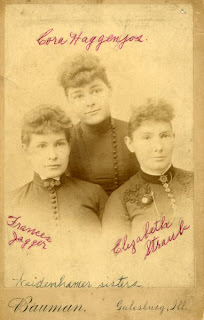
Corporal Albert B. Straub (pictured) was at the Battle of Shiloh, April 6 & 7, 1862. At that same battle, on the Confederate side, was Pvt. Othaniel Arthur Rice, 2nd great-grandfather of Charlotte Anne Donald Muffley, my deceased first wife. Othaniel, formerly a plantation overseer, was in the First Regiment of Mississippi Cavalry at Shiloh; after the battle he was hospitalized at a makeshift hospital at the University of Mississippi in Oxford, Mississippi, and he died there.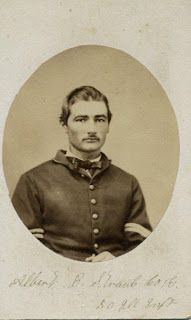 At the Battle of Shiloh, Tennessee, Albert B. Straub’s 50th Illinois Infantry was in the 3rd Brigade (& J.C. Weidenhamer’s 12th Illinois Infantry was in the 2nd Brigade) of the 2nd Division under Brigadier General W.H.L. Wallace. The 2nd Division was part of the Army of the Tennessee, Major General Ulysses S. Grant commanding. Also at the Battle of Shiloh were some companies of the 18th Regiment of Missouri Infantry, but apparently not company K, in which there was some Pvt. Joseph M. Muffley; that regiment was stationed at Corinth awhile.
The photo of Albert B. Straub in corporal’s stripes was taken during his regiment’s stay in Corinth, Mississippi. He was in service for nearly 4 years, and was discharged as a first sergeant. In 1867, Albert B. Straub married Elizabeth Ann Weidenhamer. Albert’s work included farming, dry goods, groceries, railroading, and justice of the peace. He was Station Master for the railroad at Galesburg, Illinois, for some time. Albert and Elizabeth had at least 9 kids, contributing substantially to the huge railroading clan of Weidenhamer and associated families. See www.findagrave.com/cgi-bin/fg.cgi?page=gr&GSmcid=46770578&GRid=10065664&
JOHN CHANCY WEIDENHAM(M)ER

The largest land battle ever fought in North Carolina began on March 19, 1865. At Bentonville, Confederate forces under Gen. Joseph E. Johnston tried to stop the northward advance of Maj. Gen. William Tecumseh Sherman, who sought eventually to join forces with Gen. Ulysses S. Grant in Virginia. Confederate troops were in place across the Goldsboro Road the morning of March 19, blocking the Union Left Wing under Maj. Gen. Henry W. Slocum. The fighting was heavy, and United States forces had some setbacks.
Late afternoon on March 20, Private John Chancy Weidenhamer (eldest brother of my great-grandmother Frances Weidenhamer Jagger) arrived at the Bentonville battlefield to reinforce the Union troops. J.C. Weidenhamer had some help: Sherman’s Right Wing (Army of The Tennessee), under the command of Maj. Gen. Oliver O. Howard.
Private Weidenhamer had joined the army at age 16, threatening to run away if permission was not given. He sought to take the place of his father John Jacob Weidenhamer III, who was too ill to serve when drafted after his first discharge. J.C. had turned 16 on Aug. 2, 1864, and he was mustered in as a substitute on October 14, 1864. From November 15, the 12th Illinois Infantry was part of Gen. William Tecumseh Sherman’s March to The Sea (Savannah Campaign), with a goal of speeding the end of war. Following the Savannah Campaign, Sherman began the Carolinas Campaign, leading to the Battle of Bentonville.
When Howard’s Right Wing joined comrades at Bentonville on March 20, 1865, his troops extended Slocum’s right flank. There was heavy skirmishing on March 21. The
12th Illinois Regiment was commanded by Lt. Col. Henry Van Stellar. The 12th was part of Col. Robert N. Adams’ 2nd Brigade of Maj. Gen John M. Corse’s 4th Division of Maj. Gen. John A. Logan’s XV Corps. This corps was under Maj. Gen. Oliver O. Howard’s Right Wing (Army of The Tennessee) of Maj. Gen. William Tecumseh Sherman’s army. Over the course of the battle, the 12th Illinois Infantry Regiment advanced north behind their skirmishers parallel to, & left of, the Bentonville Road (Route 1197). They apparently held at the south rim of a now-wooded swampy ravine at Sam Howell Branch, opposite the Confederates. John Chancy Weidenhamer was reportedly never wounded, but his regiment lost 260 during the entire war. Union forces (but not the 12th) used a local home, Harper House (still standing), as a field hospital. The night of March 21 the armies were drenched by rain. The Confederates withdrew during the night, having learned that more Unions troops, under Maj. Gen. John Schofield, had reached Goldsboro, a supply depot and rail junction.
After Bentonville, the 12th Illinois occupied Goldsboro (March 24), & then Raleigh (Apr. 14). Union troops were in Raleigh when Sherman’s escort rode out to meet Confederate Gen. Joseph Johnston to negotiate the Confederate surrender. Sherman felt that he understood Lincoln’s intention to not be overly punitive to the South in the terms of surrender. The morning that Sherman was to first meet with Johnston, Sherman swore the telegraph guy to secrecy about the newly decoded telegram. The mounted escorts of Sherman & Johnston met along the road between Raleigh & Hillsboro, near Durham Station. Johnston said that he had just passed a farm where perhaps they could hold their meeting. The Bennett family (who had lost several men to the war) agreed to loan them their residential cabin while the family stayed in the kitchen cabin. Sherman showed Johnston the telegram: Lincoln had been assassinated. Sherman and Johnston met further times, after consultations with superiors. The surrender was signed on April 26, 1865, at Bennett Place.
Johnston defied Jefferson Davis, who wanted to fight on indefinitely. Sherman defied those in D.C. who wanted to be more punitive to the South. They did a good thing in ending the killing & establishing fair terms. www.civilwarhome.com/casualties.htm http://en.wikipedia.org/wiki/Bennett_Place
Lee had already surrendered to Grant at Appomattox, & Johnston’s largest surrender of Confederate troops ended the war. Sherman and Johnston also became friends. Johnston attended Sherman’s funeral in later years, stood bareheaded in the rain, caught a cold & later pneumonia, which killed him.
After the Bennett Place April 26 surrender, John Chancy Weidenhamer’s unit went on to Richmond & Washington D.C., where the 12th was in the Grand Review parade of May 24, 1865. Later, the regiment went to Louisville, and were finally discharged on July 18, 1865, at Camp Butler, Illinois.
See the regimental history at www.civilwar.nps.gov/cwss/regiments.cfm Also, see
http://en.wikipedia.org/wiki/Sherman's_March_to_the_Sea
http://en.wikipedia.org/wiki/Carolinas_Campaign
John Chancy Weidenhamer had been born on a farm in Adams County, Illinois. He did farm work, and also had hauled coal. There were several coal mines nearby. Following the December 26, 1867, marriage of Amanda Jane Griffiths (reportedly kin to Davy Crockett) and John Chancy Weidenhamer, he worked the farm awhile. J.C.’s future brother-in-law James Jagger (my great-grandfather) came from England in 1869 to mine coal in Adams County.
John Chancy Weidenhamer was listed as a farmer in the 1870 census of adjacent Schuyler County, but two of their children were buried on the Adams County side of the line, at Mt. Horeb Church. The same cemetery holds the graves of James Jagger’s first wife Jane Emmerson Liddell Jagger and their infant daughter. On December 25, 1870, James Jagger married Frances Frederika Weidenhamer, sister of John Chancy Weidenhamer.
In 1877, John Chancy Weidenhamer moved his family to Galesburg, Illinois, to work for the Chicago, Burlington, and Quincy railroad. He began the family railroading involvement, which eventually included large numbers of kin. He began as a brakeman (e.g. 1880 census of Galesburg), and became a conductor. At some point he was dragged by a waycar, and this may have contributed to his rheumatism. He died at age 54, in 1902. J.C. and Amanda were reportedly happy, and were very loving and kind parents.
ALBERT B. AND ELIZABETH ANN WEIDENHAMER STRAUB
Elizabeth Ann Weidenhamer was a sister of my ancestor Frances Fredericka Weidenhamer Jagger (b. 1855). Prior to Elizabeth’s marriage in 1867 to her second cousin Albert B. Straub, Albert was in Company E of the 50th Illinois Infantry through the Civil War. Albert’s regiment had several operations parallel to those of the 12th Illinois Infantry in which served Albert’s cousin and future brother-in-law John Chancey Weidenhamer. Both units were involved in the March to the Sea, Battle of Bentonville N.C., surrender of Confederates at Bennett Place (near Durham), and Grand Review in Washington, D. C.

Corporal Albert B. Straub (pictured) was at the Battle of Shiloh, April 6 & 7, 1862. At that same battle, on the Confederate side, was Pvt. Othaniel Arthur Rice, 2nd great-grandfather of Charlotte Anne Donald Muffley, my deceased first wife. Othaniel, formerly a plantation overseer, was in the First Regiment of Mississippi Cavalry at Shiloh; after the battle he was hospitalized at a makeshift hospital at the University of Mississippi in Oxford, Mississippi, and he died there.
 At the Battle of Shiloh, Tennessee, Albert B. Straub’s 50th Illinois Infantry was in the 3rd Brigade (& J.C. Weidenhamer’s 12th Illinois Infantry was in the 2nd Brigade) of the 2nd Division under Brigadier General W.H.L. Wallace. The 2nd Division was part of the Army of the Tennessee, Major General Ulysses S. Grant commanding. Also at the Battle of Shiloh were some companies of the 18th Regiment of Missouri Infantry, but apparently not company K, in which there was some Pvt. Joseph M. Muffley; that regiment was stationed at Corinth awhile.
The photo of Albert B. Straub in corporal’s stripes was taken during his regiment’s stay in Corinth, Mississippi. He was in service for nearly 4 years, and was discharged as a first sergeant. In 1867, Albert B. Straub married Elizabeth Ann Weidenhamer. Albert’s work included farming, dry goods, groceries, railroading, and justice of the peace. He was Station Master for the railroad at Galesburg, Illinois, for some time. Albert and Elizabeth had at least 9 kids, contributing substantially to the huge railroading clan of Weidenhamer and associated families. See www.findagrave.com/cgi-bin/fg.cgi?page=gr&GSmcid=46770578&GRid=10065664&
JEREMIAH JAGGER’S DNA KIN IN SOUTHOWRAM WEST YORKSHIRE
This is a tale of 2 Jagger lines separated by over 2 centuries in arrival in America, but united by origin village and by autosomal DNA.
Jeremiah Jagger (born January 27, 1610/1611, Southowram) was a Puritan, merchant sea captain, and co-founder of Stamford Connecticut. He arrived in New England in 1630. Some of his descendants have autosomal DNA (atDNA) matches with either me or with my cousin Randy Jagger, both of whom descend from James Jagger (b. 1843, Southowram) who arrived in Illinois before 1870. All 3 of Jeremiah’s known sons have living descendants whose atDNA appear at Family Tree DNA, AncestryDNA &/or www.gedmatch.com as our matches. There are in these databases at least 5 people with continuous lines of ancestry back to Jeremiah as of November 2018. Additionally, at www.gedmatch.com Randy Jagger’s Kit # T033828 & his Jeremiah Jagger descendant atDNA match H473581 share a Chromosome 10 segment with 13 other people. Some in this group appear to be atDNA kin to me. Some are not aware of Jagger ancestry but incidentally have Jagger in their trees.
Puritanism took root in West Yorkshire in the 1600s. https://www.calderdale.gov.uk/wtw/timeline/1600-1650/1600-1650-1.html
Northowram, home of some Jagger families, saw the growth of Non-Conformist religions in general. I.e., not Church of England.
Jeremiah Jagger (b. 1610) was aboard the flagship Arbella in the 1630 fleet of 11 ships carrying over 700 Puritans to Massachusetts. Search for the Winthrop fleet at https://www.wikitree.com/wiki/Category:Great_Migration_Ships#Winthrop_Fleet.
Jeremiah is mentioned in the Calderdale Companion at http://www.calderdalecompanion.co.uk/mmj160.html. Sir Richard Saltonstall (bapt. 1586, Halifax) was on the same ship as Jeremiah. https://en.wikipedia.org/wiki/Richard_Saltonstall Sir Richard would have been a contemporary of the unknown parents of our Jeremiah Jagger (b. 1610, Southowram, adjacent to Halifax). Jeremiah was born the same year as Richard Saltonstall, son of Sir Richard. Both Jagger & Saltonstall had several descendants in early New England. At AncestryDNA, I have an atDNA match with a person who lists ancestor Elizabeth Saltonstall (b. 1668, Massachusetts); tree by scl518. Elizabeth may or may not have been the carrier of the atDNA which is a match to me. Elsewhere, Elizabeth is listed as a great-granddaughter of Sir Richard Saltonstall (m. Grace Kaye) -& Richard Saltonstall (b. 1610; m. Muriel Gurdon) -& Col. Nathaniel Saltonstall (b. 1639, Ipswich Essex Co. Mass.; m. Elizabeth Ward) & this Elizabeth Saltonstall (b. 1668; m. Rev. John Denison & Rev. Roland Cotton).
After the 1630 arrival on Arbella, Sir Richard led a group up the Charles River & settled at current Watertown Massachusetts. Our Jeremiah Jagger lived at Watertown until 1636, when he moved to Wethersfield Connecticut. The next year, Native Americans attacked Wethersfield, killing Puritan settlers & taking many captive. Some historians believe this was a precipitating event of the Pequot War.
Jeremiah became a soldier in the Pequot War.
The war ultimately resulted in a brutal massacre at Mystic and the Pequot population was so diminished that they "ceased to be a tribe in most senses."
Reflecting on that period, Alfred Cave wrote: "Contemporary chroniclers and later historians sympathetic to the Puritans painted a portrait of the Pequots as a 'cruell, barbarous and bloudy' people," reinforced by long-standing stereotypes from the previous century that described Native American religious practices as "the Devil's instruments" out to "exterminate all Christians in New England. The Puritans and their later apologists asserted that the English colonists had no choice but to strike first."
Today, the image of Pequot native people has transformed, in part owing to critiques of historical Puritan Indian policies, as well as a growing recognition of injustices committed against Native Americans. "Pequots are now often celebrated rather than excoriated for their resistance to English expansionism" (Cave).
For more see The Pequot War by Alfred Cave:
http://www.sjsu.edu/people/ruma.chopra/courses/h170_MW_S13/s0/Wk4A_Cave_English.pdf
https://en.wikipedia.org/wiki/Pequot_War
http://pequotwar.org/about/ The Dutch (some of which were French Huguenot refugees to the Netherlands & on to America) were part of this conflict; my 9th Great-Grandmother Sarah Rapalje (b. 1625, Fort Orange/Albany; m. Teunis Bogaert) was a girl then.
Excavations of Wethersfield:
http://www.wnpr.org/post/archaeologists-discover-evidence-connecticuts-earliest-english-colony
The discovery of a palisade (fortified wall) was a surprise.
Jeremiah’s father, said to be Jonathan Jagger (b. abt. 1590), or Jonathan’s wife may have been the Most Recent Common Ancestor accounting for robust atDNA chromosomal segments (esp. the Chromosome 10 group) shared by descendants of Jagger of 1600s New England & our 1800s Southowram line. Presumably, at least one (more likely many) Jagger person(s) with the atDNA pattern seen in Jeremiah would have lived in one or more of the 25 Jagger households appearing in the 1672 Hearth Tax roll for West Yorkshire. A particular Jagger in 1672 West Yorkshire would have been ancestral to our known ancestor John Jagger (m. 1713, Halifax, to Mary Russet; d. 1772); & lived not more than 2 generations back from this John, my 6th great-grandfather.
Probably about 95% of people descending from British Jaggers derive directly from West Yorkshire. Additionally, there is a Jagger line associated with Oxfordshire, esp. Bicester. I have recently been contacted by Keith, a descendant of this latter line. We currently have no solid evidence of any relationship between the two lines, despite what might appear in any online tree.
Another Jeremiah Jagger (b. 1730; m. Sarah Binns) was the great-grandfather of Joseph Hobson Jagger (b. 1830), the guy who broke the bank at Monte Carlo. A book on Joseph Hobson Jagger has been written by Anne Fletcher. https://annefletcherauthor.wordpress.com/media/
Joseph was her 3rd great uncle. There is also an entry on Joseph in the Calderdale Companion:http://www.calderdalecompanion.co.uk/mmj160.html Over a period of 8 days in 1875 Joseph reportedly won a sum of money equivalent to £26 million today. In her book, Anne’s genealogical formulation is termed the Jaggers of Pepper Hill, Shelf. Ash Tree Farm. This line might be close kin to one or more of my past correspondents associated with the Calderdale Family History Society. https://www.cfhsweb.com/ At GEDmatch, my Kit # A693287 is not a significant match with Kit # A703534 from a probable kinswoman of Anne.
My great-grandfather James Jagger (b. 1843, Southowram) lived in Batley in 1861 with his Uncle Joseph, who had Canadian descendants who are my atDNA matches. James’ brother Will migrated to America before James; Will’s Pelosi descendant has an atDNA match with me at AncestryDNA. We may soon have atDNA from another descendant of Will.
Dean Jagger, actor. Once thought by my Grandpa Albert Muffley (m. Edna Jagger) to be Jagger kin. Grandpa apparently was right, but not in a way that we could conceive or support until now. Dean’s reported ancestry tracks back to our Jeremiah Jagger (b. 1610) of Southowram.
Jeremiah Jagger (born January 27, 1610/1611, Southowram) was a Puritan, merchant sea captain, and co-founder of Stamford Connecticut. He arrived in New England in 1630. Some of his descendants have autosomal DNA (atDNA) matches with either me or with my cousin Randy Jagger, both of whom descend from James Jagger (b. 1843, Southowram) who arrived in Illinois before 1870. All 3 of Jeremiah’s known sons have living descendants whose atDNA appear at Family Tree DNA, AncestryDNA &/or www.gedmatch.com as our matches. There are in these databases at least 5 people with continuous lines of ancestry back to Jeremiah as of November 2018. Additionally, at www.gedmatch.com Randy Jagger’s Kit # T033828 & his Jeremiah Jagger descendant atDNA match H473581 share a Chromosome 10 segment with 13 other people. Some in this group appear to be atDNA kin to me. Some are not aware of Jagger ancestry but incidentally have Jagger in their trees.
Puritanism took root in West Yorkshire in the 1600s. https://www.calderdale.gov.uk/wtw/timeline/1600-1650/1600-1650-1.html
Northowram, home of some Jagger families, saw the growth of Non-Conformist religions in general. I.e., not Church of England.
Jeremiah Jagger (b. 1610) was aboard the flagship Arbella in the 1630 fleet of 11 ships carrying over 700 Puritans to Massachusetts. Search for the Winthrop fleet at https://www.wikitree.com/wiki/Category:Great_Migration_Ships#Winthrop_Fleet.
Jeremiah is mentioned in the Calderdale Companion at http://www.calderdalecompanion.co.uk/mmj160.html. Sir Richard Saltonstall (bapt. 1586, Halifax) was on the same ship as Jeremiah. https://en.wikipedia.org/wiki/Richard_Saltonstall Sir Richard would have been a contemporary of the unknown parents of our Jeremiah Jagger (b. 1610, Southowram, adjacent to Halifax). Jeremiah was born the same year as Richard Saltonstall, son of Sir Richard. Both Jagger & Saltonstall had several descendants in early New England. At AncestryDNA, I have an atDNA match with a person who lists ancestor Elizabeth Saltonstall (b. 1668, Massachusetts); tree by scl518. Elizabeth may or may not have been the carrier of the atDNA which is a match to me. Elsewhere, Elizabeth is listed as a great-granddaughter of Sir Richard Saltonstall (m. Grace Kaye) -& Richard Saltonstall (b. 1610; m. Muriel Gurdon) -& Col. Nathaniel Saltonstall (b. 1639, Ipswich Essex Co. Mass.; m. Elizabeth Ward) & this Elizabeth Saltonstall (b. 1668; m. Rev. John Denison & Rev. Roland Cotton).
After the 1630 arrival on Arbella, Sir Richard led a group up the Charles River & settled at current Watertown Massachusetts. Our Jeremiah Jagger lived at Watertown until 1636, when he moved to Wethersfield Connecticut. The next year, Native Americans attacked Wethersfield, killing Puritan settlers & taking many captive. Some historians believe this was a precipitating event of the Pequot War.
Jeremiah became a soldier in the Pequot War.
The war ultimately resulted in a brutal massacre at Mystic and the Pequot population was so diminished that they "ceased to be a tribe in most senses."
Reflecting on that period, Alfred Cave wrote: "Contemporary chroniclers and later historians sympathetic to the Puritans painted a portrait of the Pequots as a 'cruell, barbarous and bloudy' people," reinforced by long-standing stereotypes from the previous century that described Native American religious practices as "the Devil's instruments" out to "exterminate all Christians in New England. The Puritans and their later apologists asserted that the English colonists had no choice but to strike first."
Today, the image of Pequot native people has transformed, in part owing to critiques of historical Puritan Indian policies, as well as a growing recognition of injustices committed against Native Americans. "Pequots are now often celebrated rather than excoriated for their resistance to English expansionism" (Cave).
For more see The Pequot War by Alfred Cave:
http://www.sjsu.edu/people/ruma.chopra/courses/h170_MW_S13/s0/Wk4A_Cave_English.pdf
https://en.wikipedia.org/wiki/Pequot_War
http://pequotwar.org/about/ The Dutch (some of which were French Huguenot refugees to the Netherlands & on to America) were part of this conflict; my 9th Great-Grandmother Sarah Rapalje (b. 1625, Fort Orange/Albany; m. Teunis Bogaert) was a girl then.
Excavations of Wethersfield:
http://www.wnpr.org/post/archaeologists-discover-evidence-connecticuts-earliest-english-colony
The discovery of a palisade (fortified wall) was a surprise.
Jeremiah’s father, said to be Jonathan Jagger (b. abt. 1590), or Jonathan’s wife may have been the Most Recent Common Ancestor accounting for robust atDNA chromosomal segments (esp. the Chromosome 10 group) shared by descendants of Jagger of 1600s New England & our 1800s Southowram line. Presumably, at least one (more likely many) Jagger person(s) with the atDNA pattern seen in Jeremiah would have lived in one or more of the 25 Jagger households appearing in the 1672 Hearth Tax roll for West Yorkshire. A particular Jagger in 1672 West Yorkshire would have been ancestral to our known ancestor John Jagger (m. 1713, Halifax, to Mary Russet; d. 1772); & lived not more than 2 generations back from this John, my 6th great-grandfather.
Probably about 95% of people descending from British Jaggers derive directly from West Yorkshire. Additionally, there is a Jagger line associated with Oxfordshire, esp. Bicester. I have recently been contacted by Keith, a descendant of this latter line. We currently have no solid evidence of any relationship between the two lines, despite what might appear in any online tree.
Another Jeremiah Jagger (b. 1730; m. Sarah Binns) was the great-grandfather of Joseph Hobson Jagger (b. 1830), the guy who broke the bank at Monte Carlo. A book on Joseph Hobson Jagger has been written by Anne Fletcher. https://annefletcherauthor.wordpress.com/media/
Joseph was her 3rd great uncle. There is also an entry on Joseph in the Calderdale Companion:http://www.calderdalecompanion.co.uk/mmj160.html Over a period of 8 days in 1875 Joseph reportedly won a sum of money equivalent to £26 million today. In her book, Anne’s genealogical formulation is termed the Jaggers of Pepper Hill, Shelf. Ash Tree Farm. This line might be close kin to one or more of my past correspondents associated with the Calderdale Family History Society. https://www.cfhsweb.com/ At GEDmatch, my Kit # A693287 is not a significant match with Kit # A703534 from a probable kinswoman of Anne.
My great-grandfather James Jagger (b. 1843, Southowram) lived in Batley in 1861 with his Uncle Joseph, who had Canadian descendants who are my atDNA matches. James’ brother Will migrated to America before James; Will’s Pelosi descendant has an atDNA match with me at AncestryDNA. We may soon have atDNA from another descendant of Will.
Dean Jagger, actor. Once thought by my Grandpa Albert Muffley (m. Edna Jagger) to be Jagger kin. Grandpa apparently was right, but not in a way that we could conceive or support until now. Dean’s reported ancestry tracks back to our Jeremiah Jagger (b. 1610) of Southowram.
GALESBURG, KNOX COUNTY, ILLINOIS, AND BEYOND
 My grandmother Edna Una Jagger (pictured) was born in Galesburg on March 1, 1887. In 1888, Jessie and Amelia Jagger Hallas moved from Batley, West Yorkshire, to live in Galesburg. Amelia was James Jagger’s first cousin. In 1888-1890, a registered voter in Chicago was Squire Jagger, born in Delaware; this was almost certainly the son of Will Jagger (brother of our James Jagger). Squire Jagger has not been located in any subsequent document.
By then there was quite a spread in ages of the James and Frances Jagger kids. Edna’s sister Mary Alice “May” Jagger married in 1890 Silas William McCreary, so that May married into a generation older than the other kids. Silas McCreary was a brother of Emma Jane McCreary, wife of Joseph Pierce Muffley. It was Joe’s and Emma’s son Albert Muffley who eventually married Edna Jagger. Confused? Silas and May were called Cuz-Unc and Cuz-Aunt.
 The lives of Albert and Edna Muffley (pictured on the left) will be discussed in the Muffley Blog. Edna’s siblings and cousins were numerous, and they had a club “Ums-O-Wees”. Albert had a tee shirt labeled, “Ums-O-Wees Motorcycle Club”.
In 1891, Edna Jagger’s sister Martha Elizabeth “Mattie” Jagger sailed to England and stayed with kin for a year. Then she sailed back from Liverpool to New York, arriving on May 21, 1892. She also visited kin in Pennsylvania: James Jagger’s brother Will had lost a wife, remarried, and had kids by both wives. Will’s daughter Lizzie Jagger Snyder and family moved to Joliet Illinois, where they lived awhile, from about 1902. When they came from Pennsylvania, they were met at Union Station in Chicago by Edna’s sisters Allie and Bess. Later, Bess visited the Pennsylvania Jaggers. Charles and; Lizzie Jagger Snyder have descendants currently living in New York State.
 |
| Albert Muffley 1944 |
In 1898, the American battleship Maine was sunk at Cuba, triggering the Spanish-American War. In Galesburg, newspaper boy Lee Jagger (brother of Edna) spread the news. My grandfather Albert Lindstrom was a soldier in that war, but that is another story. My great-grandfather Joe Muffley (future father-in-law of Edna Jagger Muffley) tried to enlist, but was not considered stout enough. He was, however, stout enough to live to be over 100.
Meanwhile, back in West Yorkshire in the 1901 census, a number of Hardyman kin can be found. James Jagger’s first cousin Hannah Hardyman was then living at 5-7 Manor Drive in Halifax, as head of a household of relatives. I have photographed this place. Sometime in the early 1900s, the Aaron family opened a second shop: A1 Cash Boot Store, in Woolmarkets, Halifax. I have a photo of a print from Woolmarkets.
Edna Jagger and Albert Muffley eloped in 1906 (see Muffley Blog). Edna left from Galesburg, and Albert from Quincy. They married in Monmouth. A newspaper covering the story phoned the Jagger household for the story. That phone call was the first that Edna’s parents knew of the event.
 Edna’s brother Lee Forrest Jagger had begun railroad work in Galesburg with various station duties. In July, 1907, Lee moved to McCook, Nebraska. His cousin Jesse Roy Weidenhamer of McCook helped Lee secure a job as brakeman for the Chicago, Burlington, and Quincy Railroad. In 1913, Lee Jagger of McCook married Edna Sabin Glaze. Years later, Conductor Lee Jagger helped a nephew secure a brakeman job in McCook: Robert Pierce Muffley (my father - pictured here lower right when he was a brakeman for the Beverly Local).

The war ended in 1918. That year there was a large Weidenhamer reunion in Galesburg. Refer to the group photo at my Picasa album “Jagger-Weidenhamer Ancestry”. Each person is numbered, starting at the left in the closest row. Persons of particular interest: # 1 = James Jagger (my great-grandfather); #2 = Albert Muffley (my grandfather); #5 = Roy Weidenhamer (helped Lee Jagger get the railroad job in McCook); #7 = Robert Muffley (my father); #13 = Louise Muffley (sister of Robert Muffley); #23 = May Jagger McCreary (wife of Silas McCreary); #34 = Frances Weidenhamer Jagger (my great-grandmother); #44 = Silas McCreary (brother of Emma Jane McCreary & brother-in-law of Edna Jagger Muffley, who was the daughter-in-law of Emma); #48 = Edna Jagger Muffley (my grandmother); # 55 = Edna Glaze Jagger (wife of Lee Jagger); #66 = Allie Jagger Schneider (Edna’s sister who recorded family history; I recall Allie); & # 69 = Lee Jagger (my great-uncle, whom I recall). My grandmother wrote, “Some of the children not in picture were down by the lake or using the swing”. That probably included my Uncle Ken Muffley.
A couple of Hannah Hardyman’s letters of 1920 to James Jagger survive. She told of deaths in the family, leaving her the last alive of 12 siblings. Hannah had been on holiday to Blackpool and refers to people there; it is not known if these people might be related to John Jagger Jr., reported in family history as a manager of a Blackpool hotel. Hannah said, “…with care I might live to be very old like Grandfather Hardyman. I never knew him…” I have a copy of Hannah’s will. She died in 1938 at the age of 91, outliving James Jagger, who died in 1930 at age 87. Frances Weidenhamer Jagger also died in 1938.
Allie Jagger Schneider in 1970 compiled a list of all Jagger-Weidenhamer-Muffley-etc. kin known to be working for the railroad. Shortly before his death in 1975, Lee Jagger wrote to a Burlington Northern publication about a tally of Weidenhamer-Jagger-and more kin railroading years. Named persons times years worked per person. This list was updated in Sept. 1976, after my father’s retirement: 1612 years was the total at that point.
This link galesburgrailroadmuseum covers the work of the brakeman and conductor. My father, Robert Pierce Muffley, started as a brakeman and retired as a conductor. I fondly recall his descriptions of his work, and have been in his waycars (cabooses).
The Muffley Blog will carry further the story of descendants of my grandmother Edna Jagger Muffley. She lived to be over 100 years of age, and died in 1987. Thus, she got to know her great-grandchildren Lara and Kirk Muffley (my daughter and son). Her letters to them continued her practice of relating tidbits of family history. When she visited us one time, Lara and Kirk were dressed as Indians and tied her up to a chair. My first wife Anne (deceased in 2002) was horrified, but Grandma Muffley said to let them be. Grandma was easy-going, kindly, and had a good sense of humor.
Dr. Gary Muffley
JAGGER OF BATLEY, WEST YORKSHIRE, AND CANADA
In the Introduction section of this blog, a comment was made by Paul, who turns out to be a cousin previously unknown to me. We have exchanged interesting information about his line, which descends from Joseph Jagger (born 1817), an uncle of my James Jagger (b. 1843). Gary Muffley’s grandmother Edna Jagger Muffley was a second cousin to Remira Jagger Thistleton Brant (pictured), who was Paul’s great-grandmother. Remira lived in Batley at the time of her death in 1940. Remira’s Aunt Amelia Jagger Hallas migrated with her family to Galesburg.
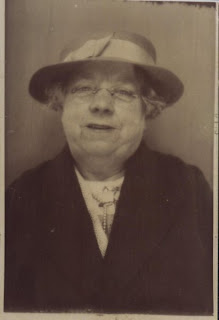
A major “Eureka” in the data exchange was in regard to Fred Jagger, who had been for years a mystery person to me. Recall that our James Jagger lived awhile (e.g. 1861 census) at 11 Whitelea Road, Batley, with the family of his uncle Joseph Jagger. Years later, the James and Emily Smith family lived at that same address in Batley. I have a letter dated November 7, 1920, from the Smith family to James Jagger in Galesburg. The letter mentions Remira (now known to be Paul’s great-grandmother), and Simpson Jagger (recalled by Paul’s father). The letter continues, “With regard to Fred Jagger and Family they came out to Canada two or three months ago and we have not heard anything about them.”
Fred Jagger was born about 1883, according to Paul, and was a son of Joseph’s son George. Fred was a half-brother to Remira, Simpson, and Emily. Fred’s siblings by his father George’s second wife Margaret Blackburn were Ada and George Jr. In the 1901 census of Batley, Fred was a colliery general labourer, and was still living with his parents and sibs. His future wife Margaret Ann Breheney, age 17, was living in Dewsbury with her parents in 1901. Before Fred, Margaret, and kids Ethel and Leonard wound up in Preston, Ontario, in 1920, there were some interesting developments.
It appears that Fred Jagger made some solo voyages to Canada before the 1920 migration with his family. The ship Empress of Ireland (ship photo on Jagger Picasa Album link) set out from Liverpool, & arrived at Halifax, Nova Scotia, on 23 April, 1908. Fred Jagger, age 25, carpenter, was bound for Toronto. His country of birth was England, & he was not stamped as a “Ret’d Canadian”, like some others on board were. It is possible that on this trip, Fred visited, or heard about, mills in Preston, west of Toronto. In 1914, the same Empress of Ireland was in a collision in the St. Lawrence River & sunk, one of Canada’s worst maritime disasters.
Fred Jagger’s marriage to Margaret Ann Breheney was probably prior to 1911, the approximate birth year of their daughter Ethel. World War I occurred 1914-1918, and it appears that our Fred Jagger was a soldier. Nevertheless, his son Leonard was born about 1916.
The ship Florizel (photo at Jagger Picasa Album) departed from St. Johns Newfoundland, & arrived at Halifax, Nova Scotia, on 6 August, 1917. The roster included Fred Jagger, age 34, a soldier born in England, & bound for Halifax, N.S. He indicated that he had been in Canada 5 years prior to that, so about 1912. The Florizel was a Red Cross Line ship, and made another run between Halifax & St. Johns in December, 1917, according to an article about a munitions ship explosion at Halifax, N.S. The Florizel herself was wrecked in February, 1918, at Newfoundland. “The SS Florizel was built for Bowring's Red Cross Line in 1909, to replace the SS Silvia. A sturdy steel ship, with ice-breaking capability, she was considered the pride of Bowring's fleet. On February 24, 1918, the Florizel was wrecked on Horn Head Point, near Cappa Hayden, Newfoundland. Out of the 78 passengers and 60 crew members, only forty-four (17 passengers and 27 crew) survived the wreck.” It appears that the Florizel was used in those years on a run between Newfoundland, Nova Scotia, and New York. Fred Jagger would have made the transatlantic run in some other ship.
The ship Minnedosa (photo on Picasa) left Liverpool & arrived on 4 September, 1920, at Quebec. On board now were Fred Jagger, age 37, Margaret Ann (Breheney) Jagger, age 37, Ethel Jagger, age 9, & Leonard Jagger, age 4. All were born in England. Destination of the Jagger family: Preston, Ontario. Mrs. T. Bradford was listed as a friend of theirs in Preston. Fred Jagger was a mill hand in England, & intended to do the same work in Ontario.
On July 28, 1925, Fred was the arrival contact in Detroit for his wife Margaret and son Leonard. The departure contact from the Canadian side was Margaret’s father Patrick Breheney. According to the record, the Fred Jagger family was en route to Galesburg, home of James Jagger’s family.
History of Preston: http://cambridgeweb.net/historical/preston.html
The Ontario Genealogical Society has a cemetery index page http://ogs.andornot.com/CemeteryIndex.aspx Entering “Jagger”, we find Frederick Jagger, Margaret Breheney Jagger, & Leonard Jagger at Section D4 Plot 13, Old Preston Cemetery, Cambridge (Preston), Waterloo County, Ontario. Preston Cemetery lies northwest of Cambridge.
So, after all of these years, the missing Fred Jagger family has been found.

A major “Eureka” in the data exchange was in regard to Fred Jagger, who had been for years a mystery person to me. Recall that our James Jagger lived awhile (e.g. 1861 census) at 11 Whitelea Road, Batley, with the family of his uncle Joseph Jagger. Years later, the James and Emily Smith family lived at that same address in Batley. I have a letter dated November 7, 1920, from the Smith family to James Jagger in Galesburg. The letter mentions Remira (now known to be Paul’s great-grandmother), and Simpson Jagger (recalled by Paul’s father). The letter continues, “With regard to Fred Jagger and Family they came out to Canada two or three months ago and we have not heard anything about them.”
Fred Jagger was born about 1883, according to Paul, and was a son of Joseph’s son George. Fred was a half-brother to Remira, Simpson, and Emily. Fred’s siblings by his father George’s second wife Margaret Blackburn were Ada and George Jr. In the 1901 census of Batley, Fred was a colliery general labourer, and was still living with his parents and sibs. His future wife Margaret Ann Breheney, age 17, was living in Dewsbury with her parents in 1901. Before Fred, Margaret, and kids Ethel and Leonard wound up in Preston, Ontario, in 1920, there were some interesting developments.
It appears that Fred Jagger made some solo voyages to Canada before the 1920 migration with his family. The ship Empress of Ireland (ship photo on Jagger Picasa Album link) set out from Liverpool, & arrived at Halifax, Nova Scotia, on 23 April, 1908. Fred Jagger, age 25, carpenter, was bound for Toronto. His country of birth was England, & he was not stamped as a “Ret’d Canadian”, like some others on board were. It is possible that on this trip, Fred visited, or heard about, mills in Preston, west of Toronto. In 1914, the same Empress of Ireland was in a collision in the St. Lawrence River & sunk, one of Canada’s worst maritime disasters.
Fred Jagger’s marriage to Margaret Ann Breheney was probably prior to 1911, the approximate birth year of their daughter Ethel. World War I occurred 1914-1918, and it appears that our Fred Jagger was a soldier. Nevertheless, his son Leonard was born about 1916.
The ship Florizel (photo at Jagger Picasa Album) departed from St. Johns Newfoundland, & arrived at Halifax, Nova Scotia, on 6 August, 1917. The roster included Fred Jagger, age 34, a soldier born in England, & bound for Halifax, N.S. He indicated that he had been in Canada 5 years prior to that, so about 1912. The Florizel was a Red Cross Line ship, and made another run between Halifax & St. Johns in December, 1917, according to an article about a munitions ship explosion at Halifax, N.S. The Florizel herself was wrecked in February, 1918, at Newfoundland. “The SS Florizel was built for Bowring's Red Cross Line in 1909, to replace the SS Silvia. A sturdy steel ship, with ice-breaking capability, she was considered the pride of Bowring's fleet. On February 24, 1918, the Florizel was wrecked on Horn Head Point, near Cappa Hayden, Newfoundland. Out of the 78 passengers and 60 crew members, only forty-four (17 passengers and 27 crew) survived the wreck.” It appears that the Florizel was used in those years on a run between Newfoundland, Nova Scotia, and New York. Fred Jagger would have made the transatlantic run in some other ship.
The ship Minnedosa (photo on Picasa) left Liverpool & arrived on 4 September, 1920, at Quebec. On board now were Fred Jagger, age 37, Margaret Ann (Breheney) Jagger, age 37, Ethel Jagger, age 9, & Leonard Jagger, age 4. All were born in England. Destination of the Jagger family: Preston, Ontario. Mrs. T. Bradford was listed as a friend of theirs in Preston. Fred Jagger was a mill hand in England, & intended to do the same work in Ontario.
On July 28, 1925, Fred was the arrival contact in Detroit for his wife Margaret and son Leonard. The departure contact from the Canadian side was Margaret’s father Patrick Breheney. According to the record, the Fred Jagger family was en route to Galesburg, home of James Jagger’s family.
History of Preston: http://cambridgeweb.net/historical/preston.html
The Ontario Genealogical Society has a cemetery index page http://ogs.andornot.com/CemeteryIndex.aspx Entering “Jagger”, we find Frederick Jagger, Margaret Breheney Jagger, & Leonard Jagger at Section D4 Plot 13, Old Preston Cemetery, Cambridge (Preston), Waterloo County, Ontario. Preston Cemetery lies northwest of Cambridge.
So, after all of these years, the missing Fred Jagger family has been found.
LEE JAGGER, DESCENDANTS, AND CLOSE KIN


On November 4, 1935, Robert Pierce Muffley (my father) became a brakeman with the CB&Q railroad in McCook, with some help from his Uncle Lee. Lee’s wife Edna died on June 30, 1936, when Harriett was 17 and Eldon was 11. Nearly a year later, my parents Robert and Frances Lindstrom Muffley were wed (June 2, 1937) in Galesburg. Frances and her daughter Shirley Coad/Muffley moved to McCook that year (see photos “Shirley Muffley, Ken Muffley and Eldon Jagger, August 1937”; and “Bob, Fran, and Shirley Muffley, August 1937”). For a time the Muffley family lived in a duplex with the Jagger family while Robert Muffley was building a home on West 3rd.

I recall June Witham (1918-1979), and agree with Shirley that June had a sweet disposition. June had club feet and had difficulty walking. June was a good friend to my mother. June required mental health treatment in mid-life. She was hospitalized at a psychiatric facility at Hastings, Nebraska, and lived for some time in Hastings while receiving outpatient care. She is said to have spent the rest of her life in Hastings, but the Social Security Death Index reports last residence as Colorado Springs.
Shirley recalled that Eldon played trombone in the McCook High School Band. He had a black dog named Smokey. Eldon raised pigeons in his back yard, as did his friend and neighbor Yule Dorwart. Eldon was “friendly and good natured”, according to Shirley, and loved to dance.
Harriett Lee Jagger married Dale Storey in 1941, the year that the Muffley family moved into the new home on West 3rd Street; Harriett and Dale had two kids: Judy and David. Barely into the new Muffley home in 1941, Shirley answered a telephone call informing her of the Japanese bombing of Pearl Harbor. After Eldon graduated from high school in 1942, he joined the navy, probably as a radio operator. A photo of him in his navy uniform appears to show him aboard the destroyer Farragut, which had previously been at Pearl Harbor during the attack. Farragut was quite active in the Pacific during the war. See http://en.wikipedia.org/wiki/
In 1946, both Eldon and Shirley entered McCook Junior College. Eldon was in pre-engineering, was called “Jag”, and was active in football. He played guard in the Sept. 20, 1946, game against Hays State College, and Yule Dorwart played end. McCook won. According to an online newspaper, Eldon was still a guard in the 1947 season, in which “…the Indians went undefeated during the regular season play for the first time in the school’s history”. In 1950, Eldon married Ruth Joan Barr Walker, who had lived as a child in Columbus, Ohio (where I lived for a time). Eldon and Ruth raised a family in California. In late 2010, I have been in first contact with descendants of Eldon and Ruth, some of whom have made entries at Ancestry.com. This Jagger Blog has been of interest to these Jagger cousins. Lee Jagger retired in 1954 at age 65. Lee and Lucy were still in a 1956 directory of McCook, but likely had vacationed in Colorado by this time. The photo of Lee, Lucy, Bess (Lee’s sister), Florence Weidenhamer, and Will Hardy Jagger (Lee’s brother) was taken at Lee’s and Lucy’s cabin at Evergreen some time prior to Bess’ death (February 1957). Will died in October, 1958. In 1972, Lee and Lucy lived at 1912 East Lake Blvd., Colorado Springs. It was from this address that Lee sent my father Lee’s article “Rerailing a Mountain of Steel”.
Eldon and Ruth Jagger divorced in 1971 in Los Angeles County. Lee died at Colorado Springs in 1975. At some point, Harriett and Dale moved into a house at 1966 East Woodman Road, Colorado Springs. Their son David had become quadriplegic following an accident while in service. Government payments to David enabled the family to live at that house in Colorado Springs, but the home was lost a few years ago when seized for road development, I think; residence in Arizona followed. At some point Judy married Michael Valentine and moved to Alaska. David died in 2000, Dale in 2007, and Judy in 2010. Harriett has had no contact with Eldon’s family for some years. She has talked of moving to McCook, and being buried eventually by her mother.
Harriett has little recall of her grandfather James Jagger (d. 1930), who died just after Harriett turned 11. Harriett recalls having ice cream at the Galesburg pharmacy of her Aunt Allie Jagger Schneider and Allie’s husband Carl H. Schneider. Allie’s work to preserve Jagger history is much appreciated by me.
Jagger and Weidenhamer railroading kin covered virtually all of the CB&Q (later Burlington Northern) main line from Chicago to Denver. I tend to think of the adult kids of James and Frances Jagger (b. 1843) as Jagger-West (mostly Nebraska & Colorado) and Jagger-East (Illinois & Iowa). Siblings Lee, Will, Jess, Bess and Mattie are in the western group. The rest are eastern. My Grandmother Edna Jagger Muffley lived in Galesburg with her family for much of her life until the move to Arizona, but in times past might have been found motorcycling in the Dakotas, walking atop Colorado mountains, etc.


So far, of the 12 adult kids of James and Frances Weidenhamer Jagger, I have been in contact with descendants of 4: My Grandma Edna (besides my own family, Cousin Karren in Arizona), Lily (second cousin Helen of Iowa City), Will (his great-granddaughters Catherine & Margaret), and Lee (Harriett, & descendants of Eldon). Future blog entries will cover more about these kinfolk.
Subscribe to:
Posts (Atom)